
Ceuta Sucks
My experience in this African-Spanish city is extremely limited. It's possible that things have changed in the past 50 years. But it's in the news, so I thought I'd try to get a column out of it

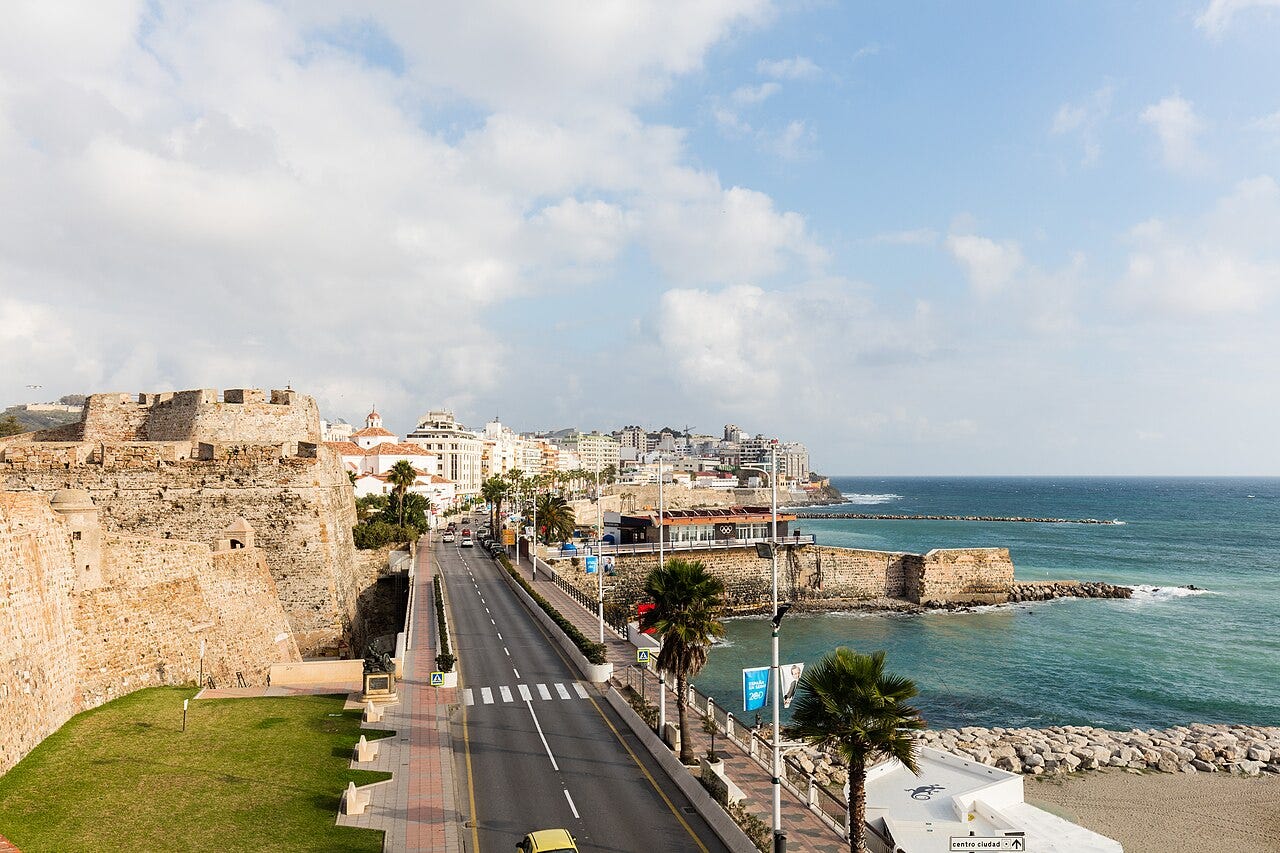
Don’t let the palm trees fool you. If you want to go to Morocco, just sail to Tangier, not Ceuta. Credit: Diego Delso/Wikimedia Commons
If you haven’t been in a dark hole watching AI videos, you know that Ceuta has been a hot topic these past few days. Fnideq (pronounced Fnideq), Morocco, is separated from the autonomous Spanish city of Ceuta by just a mile and an easy-to-climb seawall. Here’s how The New York Times explained the current situation:
In recent days, the divide between these communities collapsed as tens of thousands of migrants from Morocco and sub-Saharan Africa pushed from around Fnideq into Ceuta. The upheaval captured global attention, including that of President Trump.
Since I’m the only person you know who’s been to Ceuta, I figured I’d be a good pal and tell you what it’s like. Well, what it WAS like. In 1976. I wrote about it in my travel memoir, Just One Little Hitch, a perfect gift for that special someone™. This is an excerpt.
May 8, 1976
We arose around 7:00 and drove immediately to the ticket agency to see if the ferries would run that day. The agent said that all indications were good, but the first departure had been pushed back, so we still had time to kill. The man gave us some papers we would need to submit to passport control on departure, so we took those with us. At a kiosk we ordered coffee and donuts, and as we ate them admired the views across the harbor to Gibraltar and its famous rock on the other side of the bay. Algeciras itself, possibly thanks to my enthusiasm about the trip to Morocco, was in fact a good-looking city, with plenty of centuries-old buildings interspersed among the modern apartments. Mal dug out a boxed game of Parcheesi from the back of the Citroën, and we played several rounds at a picnic table while sipping our coffees.
The signal came, a blasting horn, alerting passengers to board the ferry, but first we were obliged to enter a drive-through passport check. Once again, I was hassled by someone in authority about not having the proper stamps in my visa pages, but I was learning that in such confrontations meekness and an air of cluelessness were more likely to get the desired results than anything like argumentativeness or assertiveness. Fortunately, I didn’t have to try hard to play the role of befuddled American tourist. We drove onto the boat.
Only as we ferried past the massive Rock of Gibraltar and into the strait that separates Europe from Africa did the thought strike me that I would be traveling to another continent, which made me happy, even proud. The sailing was smoother than I had expected, considering the Atlantic meets the Mediterranean there. I bought a ham sandwich, some almond cookies, and an Alhambra lager from the boat’s canteen, and joined Mal and Geoff in deck chairs on the sunny port side. I took off my shirt and got the start of a tan. The day had turned into something brilliant—sunny and warm with only a light breeze, an auspicious start to an adventure.
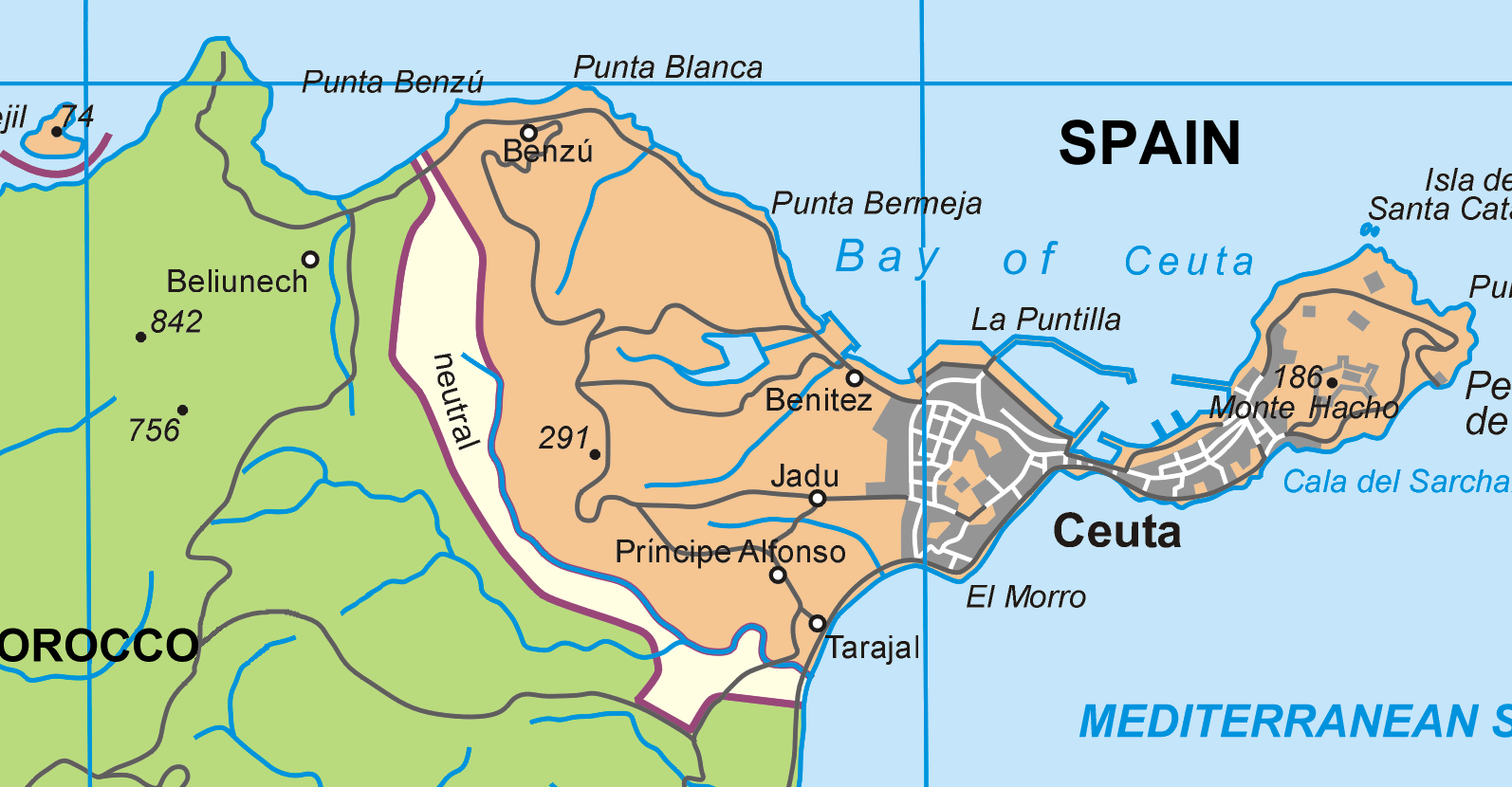
Ceuta, seven square miles of pure African goodness, owned by Spain, which holds some weird vestigial colonial claim. Credit: Aotearo/Wikimedia Commons
We had chosen to arrive in Ceuta, an autonomous Spanish city on the North African coast, rather than in Tangier, because the ferry was cheaper, not because the port offered much to see. A pinch-faced immigration officer, who curiously avoided eye contact, directed us to complete and sign various forms before stamping our passports. For some reason, cars seemed to require more paperwork than people did. We would wait in line, fill out a form, wait in line to submit it, then receive another form to fill out. The entire process took about an hour, even though only 50 or so arriving passengers filled the cavernous customs hall. I couldn’t see the sense of going through immigration formalities simply to travel from one Spanish city to another. Imagine if Americans had to pass through passport control when flying from San Francisco to Honolulu.
The immediate area around Ceuta’s port was unattractive, even outright ugly, full of warehouses, rusting steel gates pulled across access roads, and dumpy little houses on potholed streets. Not even the pleasant weather could add any luster to the place. The settlement seemed to exist for no other reason than to serve as a transit depot for goods and people. I understood how such a port would be profitable to the Spanish government by levying tariffs at both ends of the movement of goods between two continents. I could also see why any tourist landing there would want to leave in a hurry, which is what we did.
Mysterious Morocco awaited.
Please note: To avoid being murdered in my sleep by angry rogue Ceutanos, I offer you this counter-narrative.
And now, the video presents itself…
I have been to Ceuta more times than I could count. Many of my friends were born there and we have gone to visit their families. I also go sometimes when I want to go to Tetouan or Chefchaouen. I have had great food there and have been to a couple beautiful beaches. The people were always friendly.
Definitely not going there now but it is only because of the unrest and not the city. Melilla is also nice to visit.
You're the only person in my acquaintance (digital as it may be in your case) to claim to have been to Ceuta; the closest I've ever come myself is Seville (which is closer than I realized after looking at a map but still not close enough to matter by any reasonable measure). Anyhow, my only relevant comment has to do with the "GeoCities refugee" vibe coming off your counter-narrative link. I can't imagine you invested a lot of effort in your search, but if that was your best outcome then...dayum. Still waiting for my paradigm to be shifted away from "Godforsaken geopolitical hellhole."